



Last week, in our inaugural edition of The Revenue Architect, we explored “The Cost of Chaos”—the invisible tax that incomplete data convergence levies on your business. We identified three major “Drainpipes” where revenue leaks out of the organization.
Today, I want to zoom in on the very first point of failure: The Initial Drain (Error-Riddled Quotes).
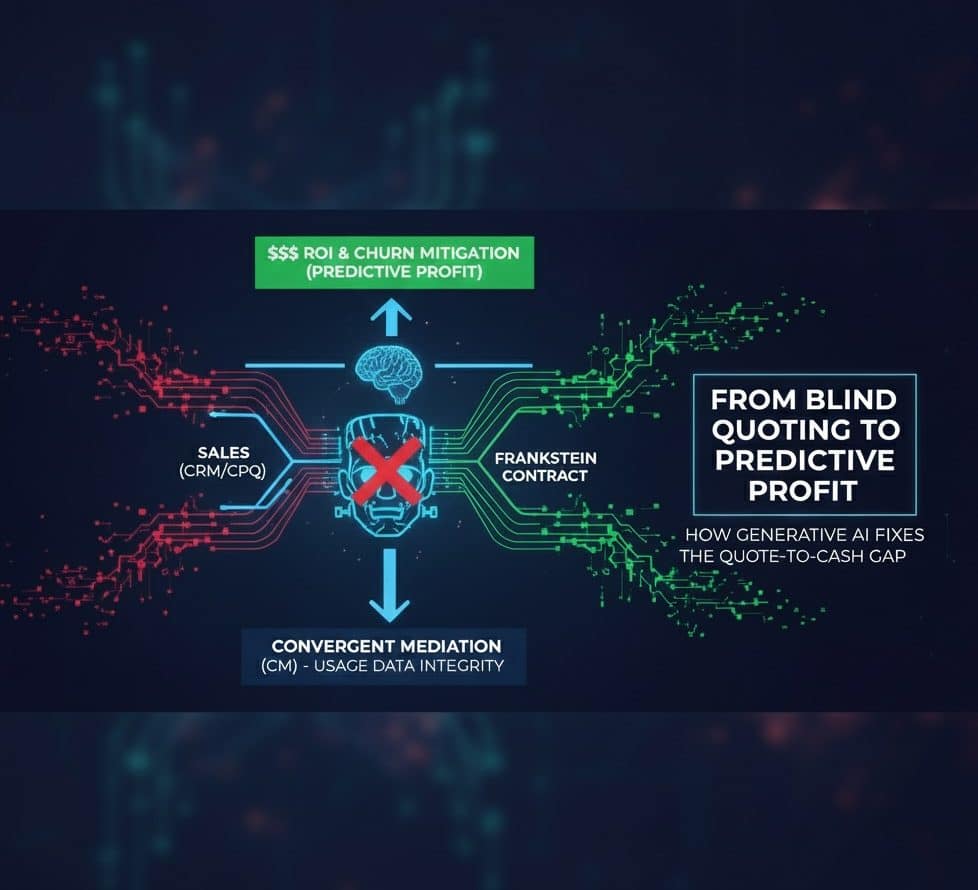
In many organizations, the Sales team (CRM/CPQ) and the Finance team (Billing/ERP) live on different planets. Sales is incentivized to close deals fast—whether gaining a new logo or renewing an existing one—often lacking visibility into the technical reality of how those deals will be measured and billed.
This disconnection creates a “Phantom Revenue” problem: You think you closed a profitable deal, but you actually signed a contract that is impossible to invoice accurately.
1. The Root Cause: “Blind” Quoting Why do quotes fail? Because the Quoting process is disconnected from the Billing reality. This “blindness” manifests in two distinct ways:
- The Problem: Without a robust Convergent Mediation (CM) layer, raw usage data from multiple sources (IoT devices, telecommunications systems, SaaS logs) reaches the billing engine (like SAP Convergent Invoicing) fragmented, delayed, or duplicated.
- The Cost: This forces finance teams to perform heavy reconciliations outside the system, delaying month-end closure by days, increasing labor costs, and often resulting in partial invoices being issued.
2. Visualizing the Loss: The “Frankenstein” Contract
When these “Frankenstein” quotes—stitched together manually outside of system logic—hit the billing engine, the value of the deal begins to degrade immediately.

As illustrated in the Value Erosion Chart above, the red line represents the “Invisible Tax” we pay for chaos. Notice how the realized revenue drops at every operational step:
- Operational Drag (First Drop): Your billing team has to manually intervene because the system rejects the new contract structure. Costs rise; margins fall.
- Customer Friction (Second Drop): The customer receives an invoice that looks different from what was promised during the handshake (“Bill Shock”). Trust is broken on Day 1, leading to disputes and credit notes.
- The Cliff (Churn): This is the silent killer. When a customer has to fight every month to get their invoice corrected due to bad initial quoting, they don’t just dispute the bill—they leave. Bad data at the quoting stage is the leading indicator of future churn.
3. The Architect’s Solution: “Usage Intelligence” at the Edge To stay on the Green Line (Intelligent Quoting), we must bring intelligence upstream into the Quoting process using Simulation:
- For New Business (Configuration Check): Before a contract is signed, the CPQ must validate the offer against the Active Product Catalog. If Sales tries to sell a product variant or pricing rule that hasn’t been configured in the backend, the quote is flagged as a deployment risk before signature.
- For Existing Business (Pattern Recognition): The system should pull actual usage data to recommend the right tier automatically, preventing “down-sell” leakage or “oversell” dissatisfaction.
Conclusion
Preparing for the Future A quote shouldn’t just be a sales document; it should be the first record of billing. By connecting your quoting tools to your revenue architecture, you stop the bleeding before the ink even dries.
But accessing the data is just step one. Next week, we will explore how Generative AI is revolutionizing this specific step—turning your sales reps from “blind quoters” into “predictive architects” who can foresee Churn Risks and create hyper-personalized offers for new prospects instantly.