



Last week, in our second edition, Stop the Bleeding Before the Ink Dries, we isolated the Initial Drain: the “Blind Quote” launched by the Sales team (CRM/CPQ) without visibility into the Billing reality (ERP/BRIM). Today, we move past simple automation.
The challenge is the fundamental disconnect: Sales (CRM/CPQ) and Finance (Billing/ERP) speak different languages. The solution to closing this Q2C gap lies in Intelligence. This week, we explore how Generative AI (Gen AI) transforms the quoting process into a self-billing, predictive Revenue Architecture.
1. The Final Challenge: The Q2C Architecture Mismatch
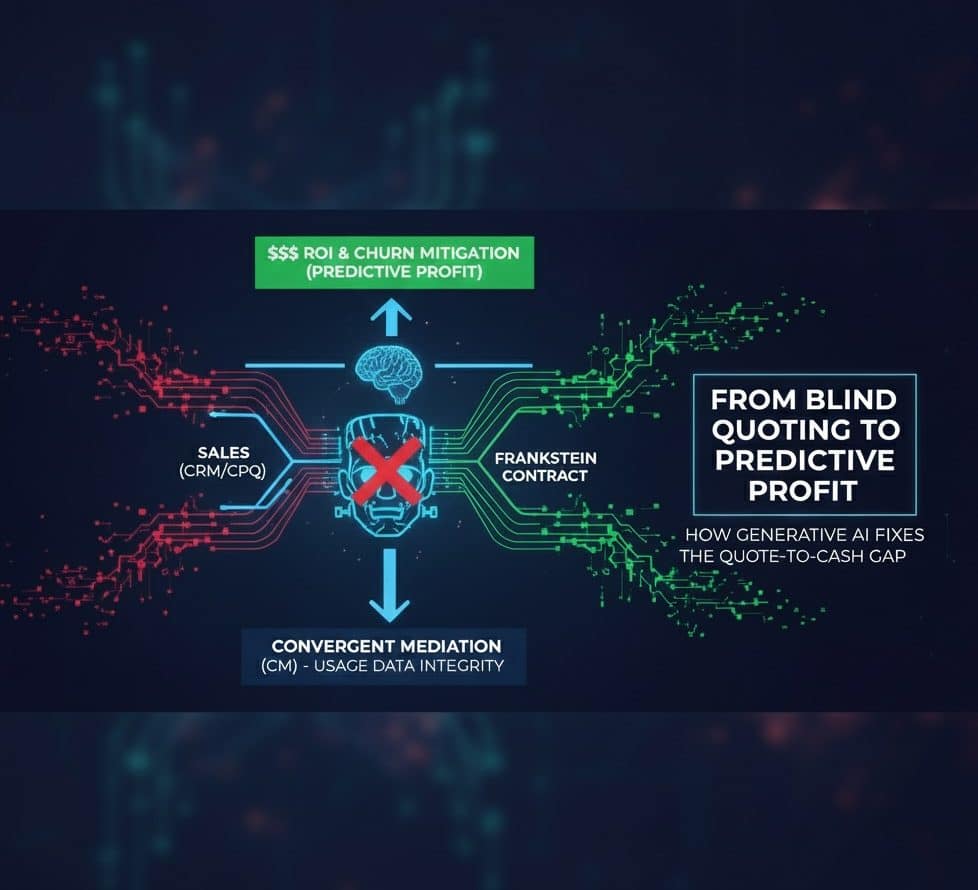
The core issue is that the Language of Business (CRM/CPQ) (terms, discounts, bundles) is inherently incompatible with the Execution Rules of the Billing Backend (ERP/BRIM). This mismatch creates the dreaded “Frankenstein Contract.”
Our goal is to inject predictive intelligence into the quote, ensuring the agreement is billable, profitable, and aligned with customer behavior.
Visualizing the Value Leakage (The “Frankenstein Contract”):

2. The Gen AI Transformation: Turning Reps into Architects
Generative AI overcomes the limitations of traditional CPQ by acting as a Real-Time Data Translator and Predictive Co-Pilot, solving problems of structure for new clients and data for existing ones.
A. New Customers: Eliminating Revenue Leakage and the Structure Trap
For new customers, the primary risk is the structural viability of the contract—sales reps creating bespoke pricing models (the “Structure Trap”) that the Billing backend cannot execute.
- Gen AI Action (Governance/Translation): The LLM consumes the natural language of the contract from the CRM/CPQ, cross-references it with the Product Catalog, and generates the necessary code and structured data guaranteed to be accepted by the Billing Core (ERP/BRIM). The contract becomes self-billable from the moment of signature, eliminating rejection risk.
B. Existing Customers: Predictive Quoting and Data Integrity
For existing customers, growth relies on retention and expansion. Predictive quoting must be based on real usage to prevent the “data blindness” of the sales rep.
- The Crucial Role of Convergent Mediation (CM): Revenue Integrity begins at the data layer. CM is the technical backbone that collects, normalizes, cleanses, and enriches billions of usage events (telecom, IoT, transactions) into clean, accurate data. Without this high-integrity data layer, the AI’s predictions are worthless.
- Gen AI Action (Predictive Analysis): The AI consumes high-integrity usage data (provided by CM) and customer behavior history.
- Result: The system provides the CPQ rep with the “Optimal Predictive Tier” for the renewal, simulating the invoice and flagging any potential “Bill Shock” or churn risk before the contract is finalized.
3. The Architect’s Solution: The Q2C Nervous System
The Intelligent Q2C Nervous System, visualized below, is the architectural blueprint for solving the disconnect. It functions by integrating intelligence into the core of the process.
- The Core Engine (Generative AI): As shown in the center, the Gen AI hub acts as the system’s brain. It houses the Translation Engine to fix the “Structure Trap” for new clients by converting natural language into structured data. Simultaneously, its Predictive Analysis module uses historical data to forecast churn risk and future usage for existing clients.
- The Foundation (Convergent Mediation): The entire system rests on the “Data Integrity Layer” provided by CM. As the diagram illustrates, CM ingests chaotic Raw Usage Events from the bottom and transforms them into High-Integrity Usage Data—the clean fuel without which the AI engine cannot run.
- The Result (Optimized Revenue): By ensuring every quote is based on clean data and translated rules, the output towards Finance is a “Perfect Billable Agreement,” leading directly to the “Optimized Revenue” growth shown on the right.
Revenue Architecture Powered by AI (The Q2C Nervous System):

From Data Chaos to Data Confidence: Through this intelligent system, we ensure that every data point, from the quote (CRM/CPQ) to the usage record, is clean, translated, and ready for invoicing (ERP/BRIM).
The Future of Monetization: A quote is no longer a promise; it is the first record of a perfect, billable invoice.
Conclusion: Demystifying the Vision and The Roadmap Ahead
I recognize that for those not deeply immersed in monetization architecture, this concept of an AI-powered “Q2C Nervous System” might sound somewhat abstract and theoretical right now.
That is completely normal, so rest assured.
It is also vital to remember where we are in our series. We are still deep within the first pillar of revenue leakage that we defined in our inaugural article. We have only just finished exploring the solution for the initial “Blind Quote” problem.
If you are new to The Revenue Architect, or if this architecture feels a bit conceptual, I strongly urge you to go back and start with Article 1: The Invisible Tax. It is crucial to understand the foundational problem before we build the advanced solution.
In the upcoming editions, we will demystify this abstraction. We will move from the “what” to the “how,” providing the practical, concrete guidelines and technical steps required to bring this powerful system to life.
Next Week’s Focus:
We will lift the hood on the Generative AI Engine. Next week, we move from high-level architecture to the Technical Blueprint: How do you actually train an LLM on billing rules without creating “financial hallucinations”? We will explore the practical reality of Fine-Tuning and the critical data infrastructure required to feed the beast in a real-world monetization stack.
Your Turn:
Does this vision of an AI-driven architecture feel abstract to you?
Share your thoughts in the comments below and let’s start the conversation.